
X (Twitter) Outreach vs Email Outreach: Which Gets Better Results in 2026?
Quick Answer
X outreach and email outreach both work, but for different goals and audiences. This guide breaks down reply rates, use cases, scaling costs, and when to use each channel.
X Outreach vs Email: The Quick Answer
X outreach gets higher reply rates for warm and semi-warm audiences. Cold email scales more cheaply and reaches people who are not on X. Neither channel is universally better. The right channel depends on who you are trying to reach, what you are offering, and what stage of the funnel you are targeting.
Use X outreach when your ideal customer is active on the platform, you are targeting founders or creators who check their DMs, or you want to warm up a relationship before sending a longer pitch. Use cold email when you need contact information you cannot get through X, when your target is in a corporate environment where email is the primary communication channel, or when your message requires attachments or long explanations.
The best-performing outreach programs use both together. This guide covers the mechanics, benchmarks, and decision criteria for each.
Reply Rates: X DMs vs Cold Email
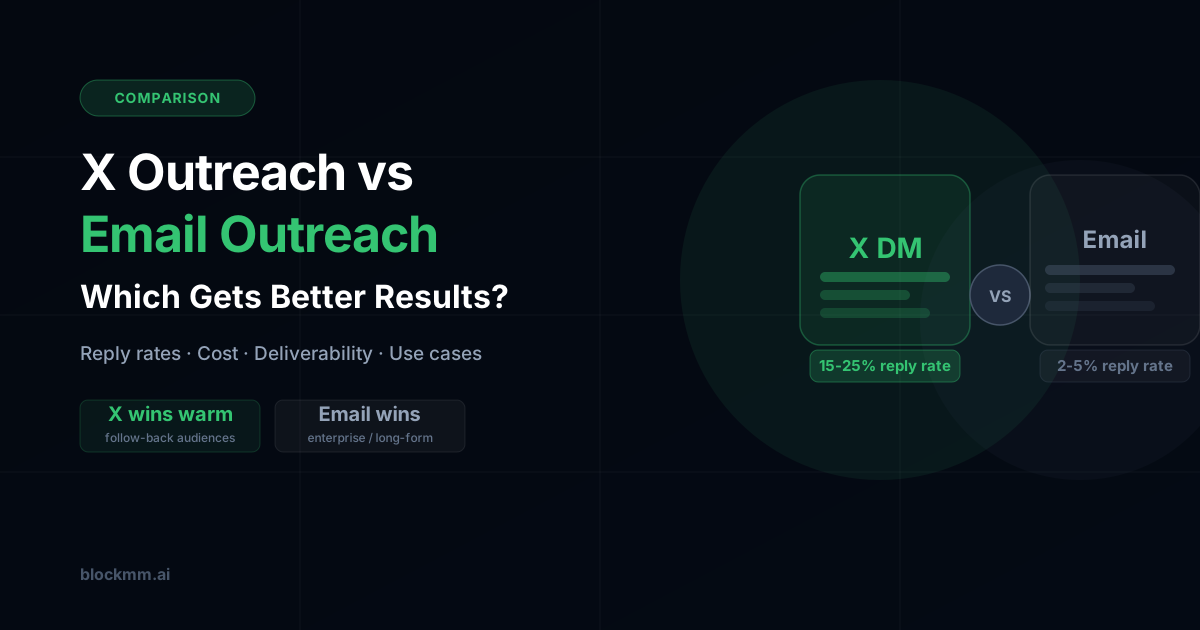
X follow-back DMs (sent to accounts that just followed you back) typically achieve 15 to 25 percent reply rates when the message is relevant and well-written. Cold X DMs to strangers range from 3 to 8 percent.
Cold email averages 2 to 5 percent reply rates for personalized campaigns to well-targeted lists. Mass email campaigns drop below 1 percent. Enterprise sales email sequences with strong personalization and multi-touch follow-up sequences can push past 10 percent, but require significant time investment per contact.
The X advantage is in the warm follow-back scenario. When someone follows you back on X after you followed them, the reply rate on an immediate DM is dramatically higher than any cold channel because the person has already shown intent. For a deeper look at why this works, read our guide on what X outreach is and how it works.
Deliverability: Where Email Loses Ground
Cold email deliverability has become a significant problem. Google and Microsoft have tightened spam filters, and sending from a new domain without a warm-up period results in emails landing in spam. Maintaining a good sending reputation requires ongoing management of bounce rates, unsubscribe handling, and domain warming.
X DMs do not have a deliverability problem in the same sense. If someone follows you back, you can DM them and the message arrives in their inbox. There is no spam folder for DMs. The constraint is volume (X flags accounts that send too many DMs too fast) rather than deliverability.
For outreach to audiences where you do not have good contact data, X removes the deliverability barrier entirely. You do not need an email address. You just need a relevant account to follow.
Scaling Costs
Cold email at scale requires an email infrastructure stack: sending domains, warming services, list acquisition or enrichment tools, and a sequencing platform. A functional cold email setup with decent deliverability runs $200 to $500 per month for a small operation, plus the cost of list data.
X outreach scales more cheaply. A tool like GeniusX starts at $20 per month and handles targeting, following, and auto DM. There is no list to buy because the platform itself contains your target audience. The main constraint is X's daily follow limits, which cap how fast you can scale.
At the high end, neither channel is free. Email requires list data and infrastructure. X requires ongoing account management and a tool to handle the following and DM steps. But the floor for X outreach is significantly lower than for cold email.
Content Limitations
X DMs are a mobile-first chat interface. They work for short, conversational messages. They do not work well for long proposals, attachment sharing, formal documents, or messages that require the recipient to click through to a separate application. The character and format constraints of DMs mean you are always writing short.
Email handles longer content naturally. You can share a PDF, attach a proposal, include images, or write a 500-word pitch without losing the reader to a character limit. For outreach where the offer requires detailed explanation, email is the better vehicle for the full pitch even if X DMs were used to warm up the relationship first.
When to Use Each Channel
Use X outreach when: your target audience is active on X (founders, creators, marketers, crypto/web3 professionals, journalists, community builders), you want to move fast with minimal setup, you are targeting accounts you already follow or who follow you, or you want to warm up a relationship before sending a formal pitch by email.
Use cold email when: your target is in a corporate or enterprise environment where X is not a primary work tool, you need to share a detailed proposal or document, your audience is in industries with lower X adoption (healthcare, manufacturing, government), or you need to contact someone whose X DMs are closed to non-followers.
Use both when: you want the X DM to start the conversation and qualify interest, then hand off to email for the deeper engagement. This is the highest-converting approach for SaaS sales, creator partnerships, and B2B lead generation because it combines the high reply rate of warm DM outreach with the scalability of email follow-up.
For specific DM templates and scripts for the X side of this approach, see our guide on cold DM templates for X outreach.
Auto Follow. Auto DM. Grow on X with GeniusX
AI finds accounts in your niche, follows them, and auto-DMs every new follower the moment they follow back. No passwords. No manual work. Starts at $20/month.
Frequently Asked Questions
- Is X outreach more effective than cold email?
- It depends on the target. For reaching founders, creators, and early-stage operators who are active on X, DM outreach typically achieves higher reply rates than cold email. For reaching mid-market enterprise buyers or HR professionals, email still outperforms X DMs because those audiences are less active on the platform. The channel should follow your audience.
- What is a good cold email reply rate?
- A well-targeted cold email campaign with strong personalization achieves 5 to 10 percent reply rates. Average campaigns with decent targeting hit 2 to 5 percent. Mass campaigns with minimal personalization fall below 1 percent. Deliverability issues from spam filters further reduce effective reply rates, making the actual delivered reply rate often lower than reported open rate figures suggest.
- What is a good X DM reply rate?
- A personalized follow-back DM sequence to a relevant audience should achieve 15 to 25 percent reply rates. Cold DMs to accounts that do not follow you range from 3 to 8 percent, depending on relevance and how well the message is written. The warm signal from a follow-back significantly lifts conversion over pure cold outreach.
- Can I run both X outreach and email outreach simultaneously?
- Yes, and the combination often outperforms either channel alone. X outreach works best for initial contact and warming the relationship. Email handles longer content, follow-up sequences, and direct links better than X DMs. A common sequence is X follow-back DM to start the conversation, then a handoff to email for deeper engagement or proposal sharing.