
How to Graduate Your hood.fun Bonding Curve: Reach $64.9k and Launch
S
Sandy
Head of Content · Block AI
Quick Answer
Everything you need to know about the hood.fun bonding curve graduation mechanics. How to push your token from $5.9k to $64.9k market cap and what happens when you get there.
<h2>How to Graduate the hood.fun Bonding Curve</h2>
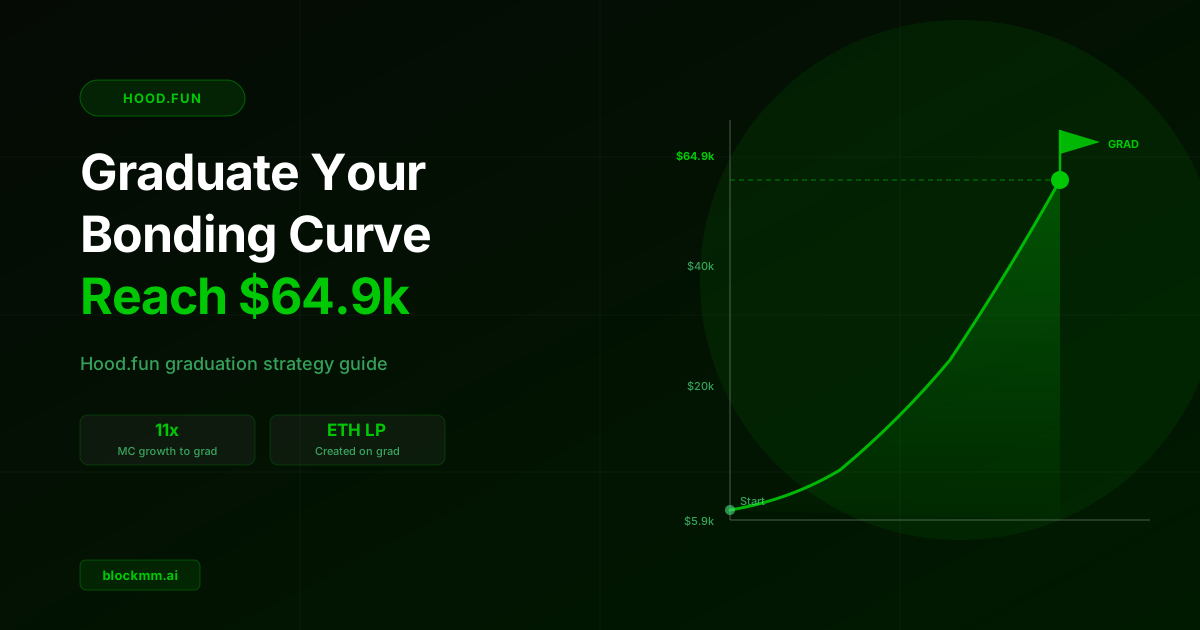
<p>Every hood.fun token starts life on a bonding curve at approximately $5,900 market cap. The goal is graduation at $64,900 market cap, the point at which the bonding curve closes, accumulated ETH is pooled, and an ETH liquidity pool is created on a DEX on Robinhood Chain. Getting from start to graduation is the central challenge of every hood.fun token launch.</p>
<p>This guide explains the mechanics of how the bonding curve works, why tokens succeed or fail to graduate, and the specific strategies that give your token the best chance of reaching that $64.9k milestone.</p>
<h3>Understanding the Hood.fun Bonding Curve Mechanics</h3>
<p>The bonding curve is an automated pricing mechanism. When someone buys your token, they are purchasing tokens out of the curve's reserve, which increases the price for the next buyer. When someone sells, tokens return to the reserve and the price decreases. The curve is continuous and deterministic: at any given supply level, the price is fixed by the curve formula.</p>
<p>Hood.fun tokens start at approximately $5,900 market cap. This is the price you see when you first launch the token before anyone has bought in. The graduation threshold is approximately $64,900 market cap. Across the curve, this represents a roughly 11x increase in market cap. The bonding curve is designed so that buying pressure across this range requires a meaningful but achievable amount of ETH from a coordinated community, rather than requiring a single whale to move the price.</p>
<p>Two important protections modify how buying works on the curve. The two-minute anti-snipe window at launch prevents bots from buying before human traders can react. The 2% maximum per-wallet cap during the bonding curve phase prevents any single wallet from accumulating a dominant position. These protections mean that graduation requires genuine community participation across multiple wallets, which also means your marketing effort directly determines whether you graduate.</p>
<p>Hood.fun also includes holder rewards, distributing a portion of trading fees to token holders during the bonding curve phase. This creates a financial incentive to hold rather than sell between buys, which reduces the constant sell pressure that can push market cap back toward the start of the curve between raid waves.</p>
<h3>Why Tokens Fail to Graduate</h3>
<p>The majority of tokens launched on any bonding curve launchpad, including hood.fun, do not graduate. Understanding why helps you avoid the same failure modes.</p>
<p>The most common failure mode is insufficient buying pressure in the first 24 hours. A token that does not reach at least $15k to $20k market cap within the first day rarely recovers. Traders scanning the hood.fun new listings feed see a token with low momentum and skip it. Without fresh external buyers, the only market participants are early holders who are increasingly tempted to sell.</p>
<p>The second failure mode is selling pressure from early buyers who bought in the first few minutes and are taking quick profits. This is partially mitigated by the 2% wallet cap, which limits how much any single wallet can sell at once, but multiple early wallets selling in the same session can still create visible downward momentum that discourages new buyers.</p>
<p>The third failure mode is narrative exhaustion. A token that launches with a compelling meme but has no active community generating new content, jokes, or engagement loses relevance quickly. On a platform like hood.fun where dozens of tokens compete for attention, narrative fatigue can kill a token's social momentum within 48 hours.</p>
<h3>Phase 1: The Launch Raid</h3>
<p>The most important single action you can take to graduate your hood.fun token is organizing a coordinated launch-day raid. A raid is a synchronized group buy from your Telegram community, timed to push the market cap visibly upward in a short window. The psychological effect of a rapid price move on the bonding curve chart is the most powerful external marketing tool available to a new hood.fun token.</p>
<p>Set up your raid coordination through your Telegram group before launch. Give your raid participants clear instructions: the contract address, the hood.fun link, the target time, and a recommended buy size. Remind them of the 2% wallet cap so they understand that smaller buys from more wallets are preferable to one large buy from a single wallet.</p>
<p>The launch raid should target pushing the market cap past $20k in the first session. This threshold signals momentum to external traders and creates a visible green candle on the bonding curve chart that will attract attention. For detailed raid coordination tactics, see our guide on how to organize a <a href="/articles/static/telegram-raid-organize-crypto-community">Telegram raid</a>.</p>
<p>If you want professional raid support, <a href="/articles/static/crypto-raid-services-2026">crypto raid services</a> provide coordinated buying campaigns with participants across multiple wallets that can push your bonding curve through key market cap thresholds without relying solely on your own community.</p>
<h3>Phase 2: Volume Maintenance Between Raids</h3>
<p>Between raid sessions, the bonding curve will naturally experience selling pressure as short-term traders take profits. Your job during the gaps between raids is to minimize sell pressure and maintain community confidence that graduation is achievable.</p>
<p>Post in your Telegram group regularly. Share the current market cap, celebrate milestones ($10k, $20k, $30k, $40k, $50k, $64.9k), and keep the community engaged with content about the token's narrative. A Telegram group that goes silent for four hours during a non-raid period signals to holders that momentum is dead, which triggers selling.</p>
<p>Keep posting on X. Your X presence during the bonding curve phase is not just for attracting new buyers, it is also for keeping existing holders confident that external interest exists. A token with active X posting looks like a project with genuine community behind it. A token that goes quiet on X after the launch post looks like it has been abandoned.</p>
<p>Use <a href="/articles/static/crypto-community-engagement-tactics">community engagement tactics</a> to keep your Telegram and X communities active between raid waves: polls about the token's narrative, meme contests, milestone countdowns toward graduation, and regular market cap updates that celebrate progress toward the $64.9k target.</p>
<h3>Phase 3: The Final Push to $64.9k</h3>
<p>The final phase, pushing from $50k toward the $64.9k graduation threshold, is typically the most exciting and the most volatile. At this point, external traders watching the hood.fun leaderboard can see that your token is close to graduation, which attracts speculative buyers hoping to ride the graduation event pump.</p>
<p>Plan your biggest raid wave for this phase. Coordinate your entire Telegram community for a simultaneous buy at a specific time when you are within $10k of graduation. Alert your KOL contacts that graduation is imminent. Post on X with a countdown to graduation. The combination of your community raid and external speculative buying from traders watching the leaderboard often creates enough buying pressure to push through the final threshold quickly.</p>
<p>The <a href="/product/reply-guy-service">reply guy service</a> is effective during this phase: active reply threads under your X posts from engaged community members signal to external traders that real people are following and excited about the token, which increases the chance of organic buying from outside your core community.</p>
<h3>What Happens at Graduation</h3>
<p>When the market cap hits $64.9k, the bonding curve closes. The ETH accumulated from net buys during the bonding curve phase is automatically deployed as an ETH liquidity pool on a DEX on Robinhood Chain. Your token is now tradeable on the open market with real on-chain liquidity.</p>
<p>The graduation event itself is often accompanied by a sharp price increase as speculative traders who were waiting for graduation buy in immediately. This is followed, in most cases, by a sharp sell-off from early bonding curve holders taking profits. Managing this transition well is the key to building long-term price stability post-graduation.</p>
<p>For support across the full journey from bonding curve launch to graduation and beyond, explore <a href="/marketing">blockmm.ai's full token promotion services</a>. Our team works with hood.fun launches specifically and understands the rhythm of the bonding curve promotion cycle on Robinhood Chain.</p>
<h2>Frequently Asked Questions</h2>
<h3>How does the hood.fun bonding curve work mechanically?</h3>
<p>The hood.fun bonding curve is an automated market maker that sets the token price based on the current supply in circulation. As more tokens are bought, the price increases along the curve. As tokens are sold back, the price decreases. The curve starts at approximately $5,900 total market cap and closes when the market cap reaches approximately $64,900. At that point, the bonding curve ends and an ETH liquidity pool is deployed on a DEX on Robinhood Chain with the accumulated ETH from buys.</p>
<h3>What is the best time zone to run a hood.fun bonding curve raid?</h3>
<p>US Eastern afternoon hours, roughly 12pm to 5pm ET, produce the highest engagement for Robinhood Chain tokens because they capture both US coasts and some European evening activity. For Asian-market coverage, runs during the 8pm to midnight ET window reach South Korea, Japan, and Singapore during their active morning hours. Coordinating at least one US-hours raid and one Asia-hours raid per day significantly increases consistent volume.</p>
<h3>How much ETH does it take to graduate a hood.fun token?</h3>
<p>The total ETH required to push a token from the starting market cap of approximately $5,900 to the graduation threshold of approximately $64,900 depends on the ETH price at the time. At an ETH price of $3,000, roughly 20 ETH of net buying pressure is required over the bonding curve's life. This does not need to come from a single buyer: coordinated community buys across multiple wallets, each capped at 2% of supply, distribute this across many participants.</p>
<h3>Can a hood.fun token lose its graduation momentum?</h3>
<p>Yes. If selling pressure consistently exceeds buying pressure, the market cap can decline back toward the start of the curve. Tokens that briefly reach $40k or $50k and then sell back to $15k are difficult to revive because early buyers who are still holding are sitting on losses relative to their entry price. The strongest protection against momentum loss is maintaining active community engagement between raid waves so holders do not panic-sell during quiet periods.</p>
<h3>What is holder rewards on hood.fun?</h3>
<p>Hood.fun's holder rewards mechanism distributes a portion of trading fees to holders of the token during the bonding curve phase. This creates a financial incentive for early buyers to hold rather than sell immediately, which reduces selling pressure and helps sustain market cap levels between raid waves. It is a structural feature of the platform that rewards long-term holders and aligns incentives between the token launcher and early community members.</p>
Launching a token? We can help.
BlockAI runs end-to-end token launch campaigns — market making, community growth, KOL outreach, and post-launch liquidity support.
Explore token launch services