
Crypto Volume Bots for DEX: Solana, EVM, and BSC Explained
Sandy
Head of Content · Block AI
Quick Answer
How crypto volume bots work differently on Solana (Raydium, Jupiter), EVM chains (Uniswap, Arbitrum), and BSC (PancakeSwap). Gas costs, MEV exposure, detection risk, and screener coverage compared by chain.
Why Chain Choice Matters for Crypto Volume Bots
A crypto volume bot does not work the same way on every blockchain. The underlying chain architecture, DEX design, MEV landscape, gas economics, and screener coverage all affect how a volume bot performs, how much it costs to operate, and how detectable its patterns are to analytics tools and exchange listing reviewers. Choosing the right chain for your volume strategy, or understanding the constraints of the chain where your token is already deployed, is essential before configuring any volume bot setup.
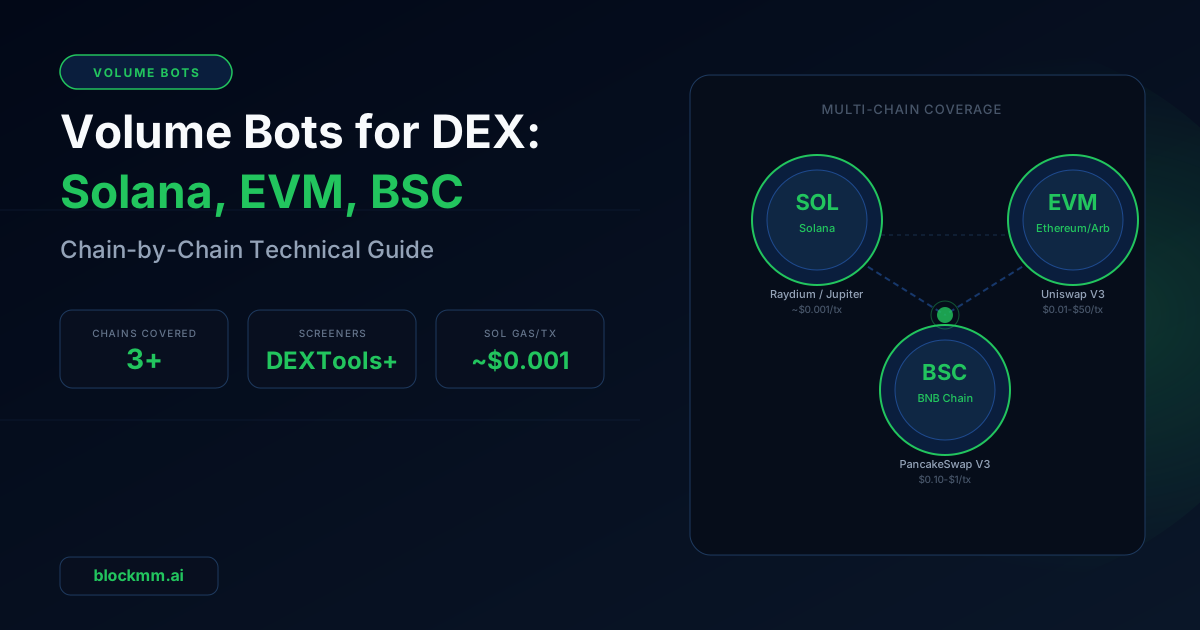
This guide examines the three primary ecosystems where volume bots are most commonly deployed: Solana, EVM chains (Ethereum mainnet, Arbitrum, and Base), and BSC. Each section covers the technical architecture differences, major DEX considerations, gas economics, MEV exposure, and detection risk profile for that ecosystem.
Crypto Volume Bots on Solana
Solana is the most cost-efficient chain for running high-frequency volume bots due to its extremely low transaction fees and fast block times. Understanding Solana's architecture helps explain both the opportunities and the unique risks of running volume bots in this ecosystem.
The scale of Solana token launches illustrates precisely why volume bots exist. In September 2026, Solana set a new all-time record with over 263,000 tokens launched in a single day, first flagged by @SolanaFloor on CryptoTwitter. According to Cryptonomist, zero reported trading volume accompanied that surge in the 24 hours following the launch spike. Tokens are trivially easy to create; generating genuine trading activity requires deliberate strategy, and volume bots are one tool teams reach for to break that initial dead-market cycle.
How Solana's Architecture Affects Volume Bot Operation
Solana uses an account-based model (not UTXO like Bitcoin) where each transaction modifies state in one or more accounts. Transaction fees are extremely low, typically between $0.0001 and $0.001 per swap, compared to $0.50 to $50 on Ethereum mainnet. This means a volume bot generating $100,000 in daily volume on Solana might pay less than $5 in gas fees per day, versus $500 to $5,000 on Ethereum mainnet for equivalent volume.
Solana's block time of approximately 400 milliseconds means transactions confirm quickly, and the throughput of 65,000 transactions per second theoretically means volume bots do not compete with organic traders for block space. In practice, Solana has experienced network congestion periods, particularly during high-activity meme coin cycles, where transaction failure rates spike significantly for bots not using priority fees correctly.
Raydium Volume Bots
Raydium is the dominant DEX on Solana and the primary target for Solana-based volume bots. Raydium operates both standard AMM pools (legacy CPMM) and CLMM (concentrated liquidity) pools. Most meme coin tokens launch on Raydium's standard AMM pools, which use a constant product formula (x*y=k) similar to Uniswap V2. Volume bots on standard Raydium pools interact with the pool's reserve accounts and generate volume that is immediately visible on DEXScreener and Birdeye.
For tokens that have migrated to Raydium CLMM pools (typically after graduating from pump.fun or similar bonding curve platforms), volume bot operation requires tracking the active price range. When a CLMM pool's price moves outside an active tick range, liquidity drops to zero and subsequent transactions fail or incur catastrophic slippage. A well-configured Raydium CLMM volume bot monitors active ranges and adjusts transaction sizes to stay within liquid price levels at all times.
Jupiter and Volume Aggregation
Jupiter is Solana's dominant DEX aggregator, routing swaps through the best available liquidity across Raydium, Orca, Lifinity, and other Solana DEXes. Volume generated through Jupiter shows up differently than direct DEX volume: it appears as Jupiter router transactions on-chain and can affect multiple pools simultaneously if the route involves hops through intermediate tokens. For volume bot purposes, using Jupiter adds a layer of abstraction that can obscure the artificial trading pattern to a degree, but it also adds routing fees on top of gas and slippage costs.
Detection Risk on Solana
Solana's detection risk profile is unique. Birdeye, the dominant Solana-native analytics platform, has developed sophisticated pattern recognition for Solana trading data, specifically because the ecosystem experienced extensive wash trading during the 2024 memecoin cycle. Birdeye's "Smart Money" and "Top Traders" categorizations actively identify wallets that exhibit wash trading patterns and exclude them from metrics designed to highlight genuine trader activity.
DEXScreener also covers Solana comprehensively and applies its own trending algorithm that weighs volume momentum. Because Solana transaction fees are so low, the threshold for manipulating DEXScreener trending is relatively low in absolute dollar terms, which paradoxically makes Solana trending activity less credible to sophisticated observers compared to EVM trending, which requires more genuine capital to achieve.
Crypto Volume Bots on EVM Chains
EVM chains share the Ethereum Virtual Machine architecture, which means volume bot code written for one EVM chain can typically be adapted to others with minimal changes. However, the practical operating environment differs significantly between Ethereum mainnet, Arbitrum, and Base.
Ethereum Mainnet Volume Bots
Ethereum mainnet is the most expensive and MEV-saturated environment for volume bots. Gas fees during average network conditions run $0.50 to $5 per swap transaction, and during high-demand periods can spike to $50 or more. For a volume bot targeting $100,000 in daily volume through hundreds or thousands of small swaps, mainnet gas costs can easily exceed $1,000 to $5,000 per day, making sustained high-volume operation economically irrational for most projects.
MEV exposure on Ethereum mainnet is the highest of any major chain. The Flashbots MEV-Boost infrastructure means that sophisticated searchers continuously scan the public mempool for predictable transaction patterns to front-run or sandwich. A volume bot executing regular swaps through a low-liquidity Uniswap V3 pool on mainnet becomes an extremely attractive target for sandwich attacks, where an MEV bot inserts a buy before the volume bot's buy (pushing price up) and a sell immediately after (capturing the price impact). This effectively increases the bot's slippage cost on every transaction cycle.
Arbitrum and Base Volume Bots
Arbitrum and Base are EVM Layer 2 networks that offer dramatically lower gas costs: typically $0.01 to $0.10 per transaction on Arbitrum and even lower on Base. Both networks use Ethereum for settlement but execute transactions off-chain, reducing the congestion and fee volatility of mainnet. MEV exposure on Arbitrum and Base is significantly lower than mainnet because the sequencer-based architecture reduces the ability of external bots to front-run transactions in the same way.
For volume bot operators, Arbitrum and Base offer a compelling cost profile: EVM compatibility (meaning existing bot code works with minor adjustments), lower gas costs than mainnet, DexTools and DEXScreener coverage, and reduced MEV risk. The tradeoff is that Arbitrum and Base ecosystems have lower absolute trading volume than mainnet, meaning the relative impact of artificial volume is more detectable against the lower organic baseline.
Robinhood Chain, an EVM-compatible layer-2 network, also belongs in this category. Its native launchpad hood.fun operates a bonding curve model similar to pump.fun, and volume bot operators have begun deploying EVM-compatible bots there to support tokens approaching the graduation threshold. The low-fee EVM environment makes Robinhood Chain an increasingly relevant venue for volume bot activity.
Uniswap V3 and Concentrated Liquidity Considerations
Uniswap V3 is the dominant DEX across Ethereum mainnet, Arbitrum, and Base. Its concentrated liquidity architecture means that volume bots must account for price range management. When a V3 pool's price moves to a tick range with no active liquidity, swaps fail or incur extreme slippage. A volume bot operating on a Uniswap V3 pool with thin liquidity around the current price must monitor the liquidity distribution continuously and size transactions to avoid pushing price into empty ranges. This adds significant complexity compared to basic AMM pool operation.
DexTools provides comprehensive EVM coverage with real-time chart data, pair analytics, and security audit scores. EVM tokens with active volume on Uniswap V3 are tracked in DexTools' trending algorithm, which weights 24-hour volume, holder growth, and liquidity depth. A token with strong volume but no liquidity depth will score poorly on DexTools' ranking even if the volume numbers are high.
Crypto Volume Bots on BSC and PancakeSwap
BNB Smart Chain (BSC) is an EVM-compatible chain operated by Binance that has historically attracted a large share of retail crypto activity, particularly from Asian markets. PancakeSwap V3 is the dominant DEX on BSC, and is a primary target for BSC-based volume bots.
BSC Architecture and Operating Costs
BSC uses the same EVM architecture as Ethereum but with a different validator set (21 validators vs Ethereum's proof-of-stake consensus). Gas fees on BSC are paid in BNB and are typically $0.10 to $1.00 per transaction, higher than Arbitrum or Base but significantly lower than Ethereum mainnet. Network congestion on BSC is occasional but less severe than Ethereum mainnet during peak periods.
MEV on BSC is moderate: there is an active MEV ecosystem on BSC, but it is less sophisticated than Ethereum mainnet's Flashbots infrastructure. Sandwich attacks occur on BSC but are somewhat less prevalent for typical volume bot transaction sizes than on mainnet. Using private RPC endpoints (available through several BSC node providers) reduces mempool visibility and lowers MEV exposure significantly.
PancakeSwap V3 Volume Considerations
PancakeSwap V3 uses the same concentrated liquidity architecture as Uniswap V3, meaning the same range management considerations apply. PancakeSwap has its own analytics dashboard and volume leaderboards that are widely used by BSC community members to discover new tokens. Appearing on PancakeSwap's trending lists requires consistent volume that the platform's algorithm recognizes as legitimate activity, which sophisticated volume bots can achieve but basic wash trading bots often fail to trigger correctly.
One unique risk on BSC is the prevalence of honeypot contracts, where a malicious token contract allows buying but prevents or heavily taxes selling. A volume bot that encounters a honeypot contract will be able to execute buy transactions but will fail on the sell side, accumulating token positions it cannot liquidate. Responsible volume bot operators audit any token contract before configuring a bot to trade it, and use simulation tools to verify that both buy and sell transactions succeed before deploying capital.
DEX Screener Coverage by Chain
DEX screener visibility varies by chain and platform. Understanding which screeners cover your chain is essential for targeting the right volume thresholds:
- DEXScreener: Comprehensive multi-chain coverage including Solana, Ethereum, BSC, Arbitrum, Base, and dozens of others. The primary screener used by retail traders to discover new tokens across all chains. Trending algorithm weights 24-hour volume momentum heavily.
- Birdeye: Solana-native with expanding EVM chain support. Particularly important for Solana tokens because it provides Solana-specific metrics like smart money flows, holder analytics, and volume quality scores that DEXScreener does not provide.
- DexTools: Strong EVM focus, particularly Ethereum and BSC. Provides chart data, security audit scores, and holder analytics. Widely used by European and Asian retail traders and often cited in KOL content.
- GeckoTerminal: Multi-chain coverage from CoinGecko. Provides pool-level analytics and is increasingly used as a discovery platform by traders who trust the CoinGecko brand for data quality.
The Professional Alternative Across All Chains
Regardless of which chain your token is deployed on, professional market making from a firm like BlockAI provides the same fundamental advantage over volume bots: genuine two-sided liquidity that generates real volume, tightens spreads, and creates exchange-compliant trading history. BlockAI's market making service operates across Solana, EVM chains, and BSC, adapting strategies to each chain's specific characteristics including gas economics, MEV landscape, and DEX architecture.
For Solana tokens, professional market making means native Raydium and Jupiter integration with Solana-optimized transaction strategies. For EVM tokens, it means sophisticated Uniswap V3 range management with MEV protection. For BSC tokens, it means PancakeSwap V3 deployment with honeypot and contract security verification. In every case, the result is real liquidity depth, tighter spreads, and the kind of market quality that exchange listing teams recognize and approve.
To see how professional market making works in your specific chain context, read our guide on DEX market making on Uniswap V3 or visit BlockAI's market making service to discuss your specific chain and DEX requirements.
Frequently Asked Questions
Which chain is cheapest for running a crypto volume bot?
Solana has the lowest transaction fees, with swap costs typically between $0.0001 and $0.001 per transaction. This makes high-frequency volume generation extremely cost-efficient on Solana. Arbitrum and Base are also inexpensive at $0.01 to $0.10 per transaction. Ethereum mainnet is the most expensive, with swap costs of $0.50 to $50 or more during high congestion periods.
Is MEV a significant risk for volume bots on Solana?
Yes. Solana has a sophisticated MEV ecosystem built around Jito's block engine. Volume bots with predictable transaction patterns can be identified and sandwich-attacked by MEV searchers, resulting in worse execution prices on every swap. Using Jito bundles with priority tips reduces MEV exposure but adds cost. Pattern randomization is essential to avoid becoming a predictable MEV target on Solana.
How does DEXScreener rank tokens and which chains does it cover?
DEXScreener ranks tokens primarily by 24-hour trading volume within each chain's pool listings and covers all major chains including Solana, Ethereum, BSC, Arbitrum, and Base. The trending algorithm weighs recent volume momentum, not just total volume, which means a sudden volume spike can push a token into trending even from a low baseline, making timed campaigns effective for screener visibility.
What makes Uniswap V3 volume bots more complex than basic AMM bots?
Uniswap V3 uses concentrated liquidity where liquidity providers define specific price ranges. A volume bot must stay within active liquidity ranges to avoid extreme slippage. If the bot's transactions push price outside the active range, the next swap faces zero liquidity and will fail or incur enormous slippage. V3 volume bots require continuous monitoring of the active price range and liquidity distribution across ticks.
Is BSC detection risk lower than Ethereum for volume bots?
BSC has historically attracted less scrutiny from major analytics firms compared to Ethereum, but DexTools' BSC integration and DEXScreener provide meaningful on-chain data to analysts. Detection risk on BSC is moderate. For serious projects targeting CEX listings, chain selection does not eliminate the fundamental detection risk of artificial trading patterns, which is best mitigated by transitioning to professional market making. Learn more at BlockAI's market making service.