
Building a B2B Sales Funnel for Crypto Projects Using LinkedIn
Sandy
Head of Content · Block AI
Quick Answer
The B2B buyer journey in crypto is longer, more research-intensive, and more relationship-dependent than retail. LinkedIn maps to every stage — here is how to build the funnel from first impression to signed partnership.
The B2B sales cycle in crypto differs fundamentally from retail token marketing. A retail buyer makes a decision in minutes based on narrative and social proof. A B2B buyer — an exchange evaluating a listing, a VC doing due diligence, an enterprise treasury team evaluating DeFi infrastructure — runs a process that takes weeks to months, involves multiple stakeholders, and requires layered evidence of credibility at every stage.
LinkedIn maps to this process more precisely than any other platform. It is where B2B buyers research projects before agreeing to meetings, where they check credibility signals on founders, and where they expect legitimate counterparties to have an active professional presence.
This guide covers how to build a LinkedIn-based B2B funnel for a crypto project — from targeting the right audience to converting connections into qualified conversations. For the content layer that supports this funnel, see building crypto thought leadership on LinkedIn.
Understanding the B2B Crypto Buyer Journey
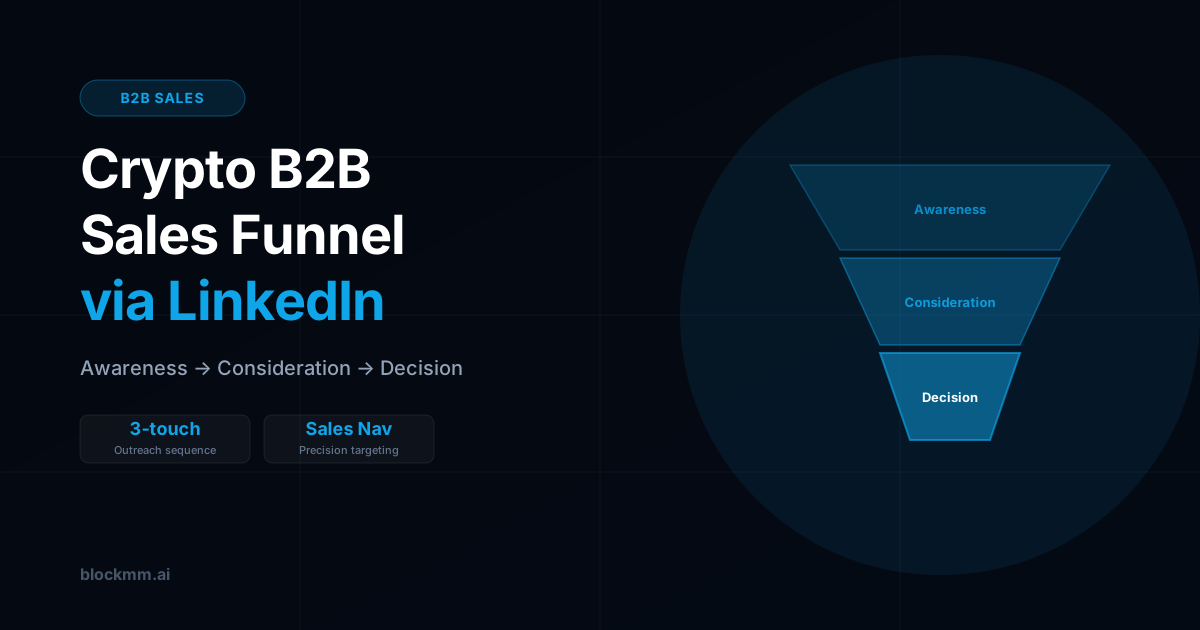
Awareness: the buyer becomes aware your project exists. On LinkedIn, this happens through: a mutual connection engaging with your founder's post, a sponsored content impression, a profile visit triggered by a comment you left on a relevant post, or an appearance in LinkedIn's "People also viewed" or "People you may know" feeds.
Consideration: the buyer researches you seriously. They visit your LinkedIn profile, read your last 5–10 posts, check your company page, look at your employee count, scan shared connections, and may check who has engaged with your content. This stage determines whether they agree to a meeting.
Decision: the buyer agrees to engage. On LinkedIn, the conversion event is typically a connection acceptance followed by a DM exchange that leads to a meeting request, or a direct inbound message if your thought leadership has already done the credibility work.
The B2B crypto cycle is longer and more research-intensive than retail. The buyer at the awareness stage is not ready for a pitch — they need to encounter your credibility signals repeatedly before they are ready to engage. Aggressive early outreach shortens the pipeline by triggering rejection before trust is built.
LinkedIn Sales Navigator for Crypto B2B Targeting
LinkedIn Sales Navigator (approximately $100/month for individual, $170/month for team) gives you filtering capabilities far beyond the free platform. For crypto B2B, the most valuable filters are:
Job title filters. Target specifically: Head of Business Development, VP of Partnerships, Investment Analyst, Managing Partner, Chief Investment Officer, Chief Technology Officer. Avoid generic "founder" or "CEO" targeting — too broad to be useful at scale.
Company size filters. For exchange partnerships, filter for companies with 200–10,000 employees (exchanges and large fintech). For VC outreach, filter for 10–200 employees (fund sizes). For enterprise DeFi, filter for 1,000+ employees (large corporates with treasury operations).
Industry filters. Financial Services, Venture Capital & Private Equity, Banking, Investment Management, and Blockchain & Cryptocurrency.
Recent activity signals. Sales Navigator allows filtering by accounts that have posted recently or accounts that have had leadership changes. Both signals indicate active organizations where outreach has more relevance.
Funding signals. Filter for accounts that have received recent funding — newly funded projects and companies that raised are expanding, evaluating new vendors, and making partnership decisions.
Connection Request Strategy That Actually Works
The default LinkedIn connection request — no message, just the generic prompt — has a 20–30% acceptance rate at best. Personalized connection requests with a specific hook perform at 50–70% acceptance from the right targets.
Effective connection request message formula (300 character limit): acknowledge a specific piece of their content or a professional milestone, make a one-sentence observation about the intersection of your work and theirs, and leave an open question or a soft invitation. No pitch, no ask for a meeting, no links.
Example structure: "I read your post on institutional DeFi custody requirements last week — the regulatory clarity point was well-argued. We are building infrastructure addressing exactly that gap from the protocol side. Would be glad to connect and compare notes."
What destroys acceptance rates: any mention of your token, any link to a whitepaper, any implied ask for money or investment, and anything that reads as a mass-copied template.
The Three-Touch Outreach Sequence After Connecting
After a connection accepts, do not send an immediate pitch. The sequence that converts:
Touch 1 (day 1–2 after connecting): a short message acknowledging the connection and making a specific observation about their work or company. No ask.
Touch 2 (day 7–10): share a piece of your content that is genuinely relevant to a specific challenge or interest evident from their posts or profile. Frame it as "thought this might be relevant given [specific thing]." No ask.
Touch 3 (day 14–21): a direct, specific meeting request. "I would welcome 20 minutes to discuss [specific topic relevant to them]. Happy to work around your schedule — [link to calendar] or just reply with a time that works." Be specific about what the conversation is about. "A quick call" is vague and easy to deprioritize.
Converting LinkedIn Connections Into Telegram and Phone Meetings
The end goal of LinkedIn B2B for crypto is to move the conversation to a direct communication channel — a Telegram DM, a Zoom call, or an in-person meeting at a conference. LinkedIn is the credibility layer, not the relationship layer.
The conversion language that works: "We have more to discuss than fits in a DM here — happy to continue on Telegram if that's easier for you" (Telegram is crypto-native and signals you know the industry's communication norms) or "Would you be open to a 20-minute video call to go deeper on [specific topic]?"
LinkedIn Events are an underused conversion tool for crypto BD. Host a LinkedIn Event — a virtual roundtable on institutional DeFi adoption, for example — invite your target connections, and use the event registration as a warm lead list. Attendees who register are explicitly signaling interest in the topic, giving you a context for follow-up that feels collaborative rather than sales-driven.
For the partnership outreach strategy that takes relationships from LinkedIn into formal BD processes, see how to land Web3 partnerships.