
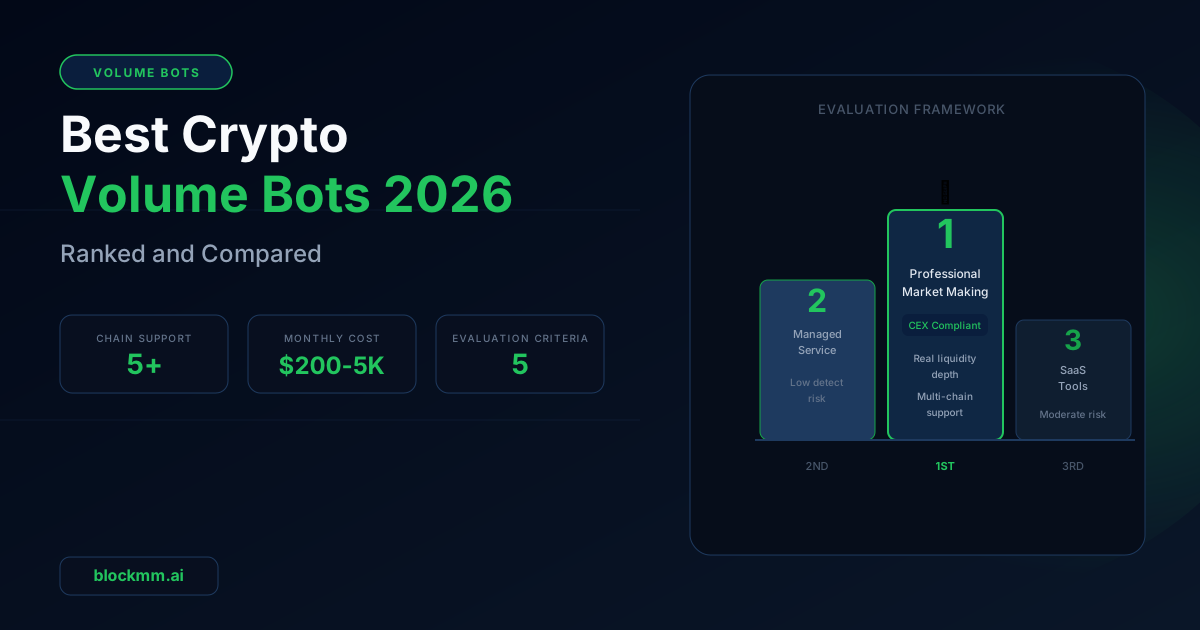
Best Crypto Volume Bots in 2026: Ranked and Compared
Sandy
Head of Content · Block AI
Quick Answer
Evaluating crypto volume bot services in 2026: what to look for, what to avoid, and why professional market making consistently outperforms volume bots for serious token projects.
The Crypto Volume Bot Market in 2026
The market for crypto volume bot services has expanded significantly since the early days of manual wash trading. In 2026, token projects can choose from a range of services spanning self-hosted open-source scripts to fully managed enterprise-grade volume generation platforms. Each category carries a different risk profile, cost structure, and capability set. This guide provides a framework for evaluating volume bot services objectively, without endorsing specific tools, and explains why professional market making consistently outperforms all volume bot categories for the outcomes that matter most.
The fundamental problem with every volume bot service, regardless of category, is that they generate artificial trading activity rather than real liquidity. This distinction seems subtle but has enormous practical consequences: exchange listing teams, on-chain analytics firms, and sophisticated institutional investors all know how to differentiate artificial volume from genuine market activity. Understanding this context is essential before investing in any volume bot service.
How to Evaluate a Crypto Volume Bot Service
When assessing any volume bot service or tool, five evaluation criteria separate high-quality options from dangerous ones. Apply these criteria systematically before committing to any service.
Chain and DEX Support
The most basic requirement: the service must support the chain and DEX where your token is deployed. In 2026, the major chains requiring volume bot support are Solana (Raydium, Jupiter), Ethereum (Uniswap V3), Arbitrum (Uniswap on Arbitrum), Base (Aerodrome, BaseSwap), and BSC (PancakeSwap V3). A service that only supports one or two chains severely limits flexibility as projects migrate between ecosystems or deploy on multiple chains simultaneously.
Beyond basic chain support, evaluate DEX-specific compatibility. Concentrated liquidity DEXes like Uniswap V3 and Raydium CLMM require more sophisticated bot logic than basic AMM pools, because transactions must stay within active liquidity ranges to avoid excessive slippage. A volume bot that was built for basic AMM pools may perform poorly or generate suspicious slippage patterns on CLMM pools.
Detection Risk
Detection risk is the most important evaluation criterion for any project planning a CEX listing. High-detection-risk bots use simple, regular patterns: fixed transaction intervals, fixed transaction sizes, and a small number of wallets cycling through predictable buy-sell loops. These patterns are trivially detectable by any analyst with basic on-chain tooling.
Low-detection-risk bots invest heavily in randomization: Poisson-distributed transaction timing, variable transaction sizes drawn from realistic distributions, large wallet pools with rotation logic, and transaction batching that mimics the behavior of multiple independent traders. Evaluating a service's detection risk requires asking specific questions about how they randomize patterns, how many wallets are used per $100,000 of daily volume, and whether the service has any documented cases of exchange listing rejection among its clients.
Cost Structure
Volume bot services use several pricing models. The most common is a flat monthly subscription of $200 to $5,000, tiered by target volume level. Some services charge a percentage of volume generated, typically 0.1% to 1%, which aligns the service's incentive with generating volume but can become extremely expensive at higher volume levels. A few enterprise services charge a setup fee plus ongoing management fees.
The subscription fee is only part of the true cost. Gas fees and slippage losses from continuous trading cycles are real operational expenses that must be budgeted separately. On Ethereum mainnet, gas costs alone can exceed the subscription fee at high volume levels. On Solana, gas costs are negligible, but slippage losses on smaller pools still accumulate. When comparing services, calculate the total monthly cost including estimated operational expenses, not just the subscription price.
Customer Support Quality
Volume bot services that provide only automated onboarding with no human support are risky for production use. When a bot misconfigures and starts accumulating losses, or when a wallet gets flagged and you need to rotate infrastructure, response time matters. Evaluate support quality by checking how quickly the team responds to pre-sales questions, whether they have a dedicated support channel (Telegram, Discord, or email), and whether they offer incident response for critical failures.
Safety Features
Responsible volume bot services include safety features that prevent catastrophic failures: stop-loss mechanisms that halt the bot if losses exceed a threshold, maximum slippage limits per transaction, circuit breakers that pause the bot during extreme market volatility, and wallet balance monitoring that alerts when operating funds are running low. Services without these safety features expose operators to scenarios where a misconfigured bot can drain the project wallet in hours.
Categories of Volume Bot Services
Volume bot services fall into three broad categories, each with distinct characteristics, risk profiles, and appropriate use cases.
Self-Hosted Open-Source Scripts
The lowest-cost entry point: open-source scripts published on GitHub that operators run on their own infrastructure. These scripts are typically written in Python, TypeScript, or Rust and interact directly with DEX contracts via the chain's RPC endpoints. They require meaningful technical expertise to configure, deploy, and maintain. The operator manages their own wallets, funds, and infrastructure, which provides maximum control but also maximum operational burden.
Detection risk for self-hosted scripts is generally high because they implement simple randomization that experienced analysts can identify. Most open-source scripts were written for personal use rather than production deployment, and lack the sophisticated pattern-masking that professional services invest in. For projects where CEX listing is not a near-term priority and where technical expertise is available, self-hosted scripts provide a low-cost way to maintain minimum volume floors on DEX screeners. Projects launching on bonding curve platforms such as pump.fun or hood.fun on Robinhood Chain commonly use these bots to build momentum toward the graduation threshold before switching to a professional market maker.
Subscription SaaS Volume Bot Tools
The mid-market category: web-based platforms with dashboards, multi-chain support, and pre-configured bot strategies. These services typically charge $100 to $2,000 per month and abstract away the technical complexity of running volume bots. They handle wallet management, transaction signing, and monitoring through their platform infrastructure.
Detection risk varies widely in this category. Better-quality SaaS tools invest in multi-wallet rotation, realistic transaction timing, and support teams that actively monitor for pattern anomalies. Lower-quality tools are essentially wrappers around basic scripts with a web interface. The most important evaluation question for any SaaS tool is: can you get a reference from a project they have served that successfully listed on a major CEX after using the service? If they cannot provide references, treat their detection risk claims skeptically.
Managed Volume Generation Services
The enterprise tier: services where a team actively manages the volume generation strategy on behalf of the client. These services typically charge $2,000 to $10,000 per month or more, and include human oversight, strategy customization, incident response, and reporting. They tend to use larger wallet pools, more sophisticated randomization, and multi-chain deployment to produce volume patterns that more closely resemble organic trading activity.
Even managed services carry significant exchange listing risk, because the fundamental activity is still artificial trading. The most sophisticated managed volume services acknowledge this limitation and often recommend transitioning to professional market making before any serious CEX listing attempt.
Why Volume Bots Fall Short for Serious Token Projects
Every category of volume bot service shares the same fundamental limitation: they generate volume without creating liquidity. Volume is a transaction count metric. Liquidity is the ability of traders to buy and sell at fair prices with minimal price impact. A token can have impressive 24-hour volume but terrible liquidity if the volume is all circular artificial transactions with no genuine buyers and sellers at different price levels.
Exchange listing teams at Binance, Bybit, OKX, and other major venues evaluate both metrics, but they weight liquidity depth and trading pattern quality heavily. A token with $500,000 in daily volume but a $20,000 bid-ask spread and no order book depth will fail the exchange's market quality review regardless of the volume number. Professional market making addresses liquidity directly: it places real orders at multiple price levels, narrows spreads, and creates the kind of market structure that exchanges look for when deciding whether a token deserves a listing.
The other fundamental limitation of volume bots is sustainability. Volume generated by bots stops the moment the bot stops. When a project runs out of budget for the volume bot service, volume collapses overnight, which is itself a red flag that DEX screener algorithms and exchange listing reviewers notice. Professional market making generates volume from genuine spread capture, which is self-sustaining as long as organic traders are present, and grows naturally as the token gains more holders and traders over time.
Professional Market Making as the Superior Alternative
For token projects serious about major exchange listings, long-term price stability, and building credible market infrastructure, professional market making from a firm like BlockAI consistently outperforms all volume bot categories. A professional market maker provides genuine two-sided liquidity, tighter spreads that attract organic traders, exchange-compliant trading history, and the kind of institutional credibility that accelerates CEX listing conversations.
The cost difference between a volume bot service and professional market making is real, but the return on investment comparison is not close. A volume bot service might cost $1,000 per month while generating detectable artificial patterns that close CEX listing doors. Professional market making might cost $5,000 to $15,000 per month while generating genuine market activity that opens those doors. For token projects with CEX listing as a strategic goal, the investment in professional market making pays for itself many times over.
Read our complete guide to best crypto market makers for a comparison of professional market making firms. To explore what professional market making could do for your token's volume, liquidity, and listing prospects, visit BlockAI's market making service and reach out to our team for a consultation.
Frequently Asked Questions
What should I look for when choosing a crypto volume bot service?
Evaluate five key criteria: chain and DEX support, detection risk quality, cost structure including operational expenses, customer support responsiveness, and safety features like stop-loss mechanisms. Most importantly, evaluate whether your use case actually requires a volume bot or whether professional market making is the more appropriate solution for your project's stage and goals.
How do volume bot services charge for their services?
Most volume bot services charge a monthly subscription fee ranging from $100 to $5,000 depending on volume target and chain. Some also charge a percentage of volume generated, typically 0.1% to 1%. The subscription fee is only part of the true cost: operational expenses from gas fees and slippage losses can match or exceed the subscription fee for high-volume configurations on expensive chains like Ethereum mainnet.
What is the biggest risk of using a volume bot in 2026?
Exchange listing rejection is the most consequential risk in 2026. As more token projects target CEX listings on MEXC, Gate, HTX, and eventually Binance, the exchange compliance review process has become more sophisticated. Listing teams now routinely analyze historical trading patterns using on-chain data providers, and a history of artificial volume patterns can permanently disqualify a token from listing consideration.
Are self-hosted volume bot scripts safer than managed services?
Self-hosted scripts offer more control over wallet management and transaction patterns, but they carry higher detection risk because they typically use simpler randomization than professional managed services. They also require significant technical expertise to configure, monitor, and maintain. The cost savings versus managed services are often offset by operational complexity and the higher risk of misconfiguration causing fund loss.
Why do professional market makers outperform volume bots for exchange listing preparation?
Professional market makers generate volume through genuine two-sided liquidity provision, which creates trading patterns that are indistinguishable from organic activity because they are organic activity. Exchange listing teams see compliant, normal trading history. They also see visible order book depth, tighter spreads, and evidence of institutional-quality market infrastructure that signals a serious project. Learn more at BlockAI's professional market making service.