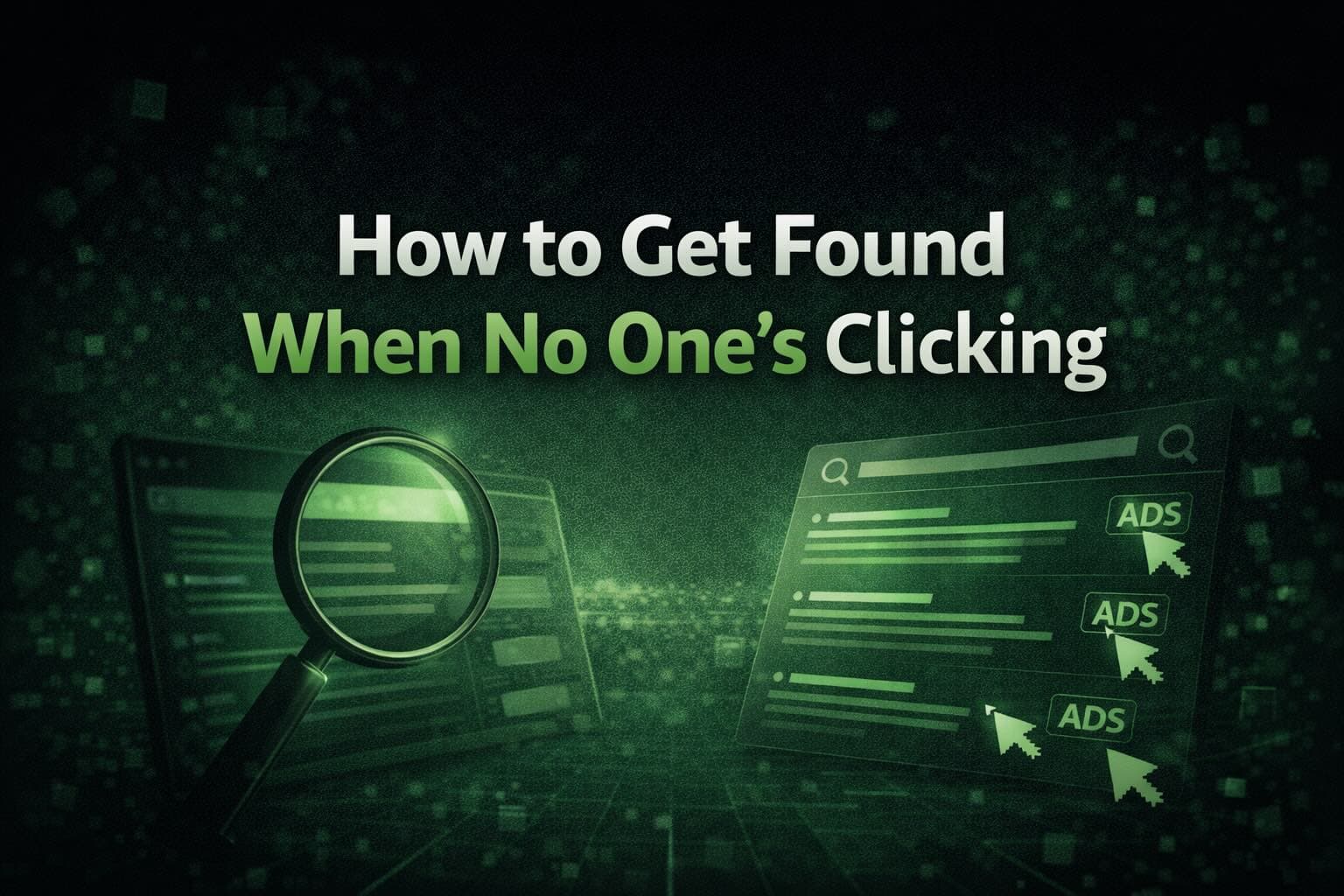
For most of the last two decades, the digital marketing playbook was built on a single assumption: people search, they click, they visit your site, you convert them. That assumption is dead.
AI-powered search tools — ChatGPT, Perplexity, Google's AI Overviews, and a growing list of competitors — now answer questions directly. Users get what they need without ever leaving the results page. According to data from SparkToro and Datos, over 60% of Google searches in 2025 ended without a click. That number is rising. For marketers who built their entire acquisition strategy around organic traffic, this isn't a speed bump. It's a structural collapse.
The brands that will win in this new environment aren't the ones who fight the trend. They're the ones who figure out how to get cited, recommended, and remembered — even when no one's clicking.
Understanding What Changed (And Why It Won't Change Back)
The shift to zero-click search isn't a temporary algorithm tweak. It reflects a fundamental change in how people interact with information. When a user asks an AI assistant "what's the best project management tool for remote teams," they don't want ten blue links. They want an answer. And AI tools are getting very good at providing one.
This puts brands in an uncomfortable position. You can rank #1 in Google and still get zero traffic if the AI summary answers the question before users scroll down. You can publish outstanding content and never see it drive a session, because the AI pulled one paragraph from your blog and summarized it without attribution.
The old SEO metrics — rankings, organic sessions, click-through rates — are becoming less meaningful. What's replacing them is harder to measure but equally important: visibility within AI-generated answers, brand mentions in AI summaries, and share of voice in the AI's "mental model" of your category.
The Rise of Generative Engine Optimization (GEO)
A new discipline is emerging to address this shift: Generative Engine Optimization, or GEO. Unlike traditional SEO, which optimizes content to rank in search results, GEO optimizes content to be cited, referenced, or summarized by AI tools.
The principles are related but distinct. AI models tend to favor:
Authoritative, well-structured content. AI systems are trained to trust sources that demonstrate expertise. This means long-form, well-researched content with clear sourcing still matters — but the goal isn't ranking. It's being the source an AI pulls from when generating a response.
Direct, quotable answers. AI models love content that answers a question cleanly in a short paragraph before expanding on it. If your blog post buries the answer on page three, the AI won't find it. Structure your content with the answer first, context second.
Data and original research. AI models are biased toward content that contains unique data, statistics, and original insights — things that can't be synthesized from common knowledge. Proprietary research, surveys, and benchmarks get cited disproportionately.
Brand entity clarity. If your brand, product, and category aren't clearly defined and consistent across the web, AI models will struggle to represent you accurately. Ensuring your brand appears consistently — on your site, in press coverage, in directories, in social profiles — helps AI models build an accurate representation of who you are.
Building Brand Without the Click
Here's the uncomfortable truth for performance marketers: in a zero-click world, brand is the performance channel. If users encounter your brand repeatedly in AI-generated answers, in podcast recommendations, in community conversations, and in word-of-mouth — they will seek you out directly. Direct traffic, branded search, and referral become the downstream metrics that matter.
This requires a mindset shift. Brand-building has historically been treated as the soft, unmeasurable counterpart to demand generation. In a world where organic acquisition is eroding, brand investment becomes the ROI play.
Practically, this means investing in:
Thought leadership and category education. Brands that educate their category — that define the terms of the conversation — get cited when AI systems explain that category. If you coined a term or concept that the industry adopted, AI tools will reference you every time someone asks about it.
PR and earned media. Traditional press coverage remains one of the most powerful signals AI systems use to determine credibility. A mention in a recognized publication carries more weight than a hundred blog posts. Earned media strategy is back in a big way.
Podcasts and video. These formats are increasingly being transcribed and indexed by AI systems. A brand that shows up consistently in relevant podcasts builds ambient awareness that translates into AI citation and direct recall.
BlockAI
Ready to grow your project?
BlockAI provides premium marketing, market making, and launch services for crypto and Web3 projects.
Try BlockAI BotRethinking Your Measurement Framework
You cannot optimize what you cannot measure, and the old measurement frameworks don't capture zero-click value. If you're still reporting success primarily through organic sessions and keyword rankings, you're flying blind in the new environment.
Forward-thinking marketing teams are adopting new measurement approaches:
Share of AI voice. Tools are emerging that let you test how AI systems respond to category queries and measure how often your brand appears, how it's characterized, and what competitors appear alongside you. This is becoming a standard part of monthly reporting.
Branded search volume. People who encounter your brand in AI summaries often search for it directly later. Growing branded search volume is one of the clearest downstream signals of zero-click visibility working.
Direct traffic trends. As with branded search, an increase in direct traffic is often a signal that ambient brand awareness is rising — people are typing your URL rather than discovering you through a search result.
Community and mention tracking. Tools like Brandwatch, Mention, and Sparktoro let you track how often your brand appears in online conversations. In a zero-click world, this kind of ambient presence is a leading indicator of acquisition.
First-Party Data as a Competitive Moat
One of the most important strategic moves you can make in the zero-click era is to build the most robust first-party data asset in your category. When you can no longer rely on organic traffic to bring people to your site, the value of the audience you already own skyrockets.
Email lists, SMS subscribers, loyalty program members, community participants — these are people you can reach without depending on any algorithm. Every piece of content you create should have a first-party data capture mechanism attached to it. Every event, webinar, or live experience should be designed to convert attendees into owned contacts.
Brands that built strong first-party databases over the last five years are now seeing those investments pay off in ways they didn't anticipate. They're not immune to zero-click search, but they're far less dependent on it.
What You Should Do Next
The zero-click era demands a strategic reorientation, not a tactical tweak. The brands that adapt will treat content as a credibility asset rather than a traffic driver, invest in brand as a performance channel, and build the first-party data infrastructure to sustain growth independent of search algorithms.
Start by auditing your current content strategy. Ask: if none of this drove a single organic session, would it still be worth creating? If the answer is yes — because it builds authority, earns press, generates conversation, or captures leads — you're building for the right future. If the answer is no, it's time to rethink.
The click is dying. The brand that gets remembered — even when no one clicks — wins.
Frequently Asked Questions
How many Google searches in 2025 ended without a click?
According to data from SparkToro and Datos, over 60% of Google searches in 2025 ended without a click, and that number continues to rise. AI tools like ChatGPT, Perplexity, and Google's AI Overviews now answer questions directly on the results page, removing the need to visit a source website.
What is Generative Engine Optimization (GEO)?
GEO is a discipline focused on making content more likely to be cited, referenced, or summarized by AI ttools, rather than simply ranked in traditional search results. AI models favor authoritative long-form content, direct quotable answers, original research and data, and consistent brand representation across the web.
How can brands build awareness when organic clicks are declining?
Brands can invest in thought leadership that defines their category, pursue earned press coverage in recognized publications, and maintain a consistent presence in relevant podcasts and video, since these formats are increasingly transcribed and indexed by AI systems. Growing branded search volume and direct traffic are the clearest downstream signs that zero-click visibility is working.
What metrics should marketers use in the zero-click era?
Forward-thinking teams are tracking share of AI voice (how often their brand appears in AI-generated category responses), branded search volume trends, and community mention frequency using tools like Brandwatch and SparkToro. These replace organic session counts as the primary signals of digital visibility.